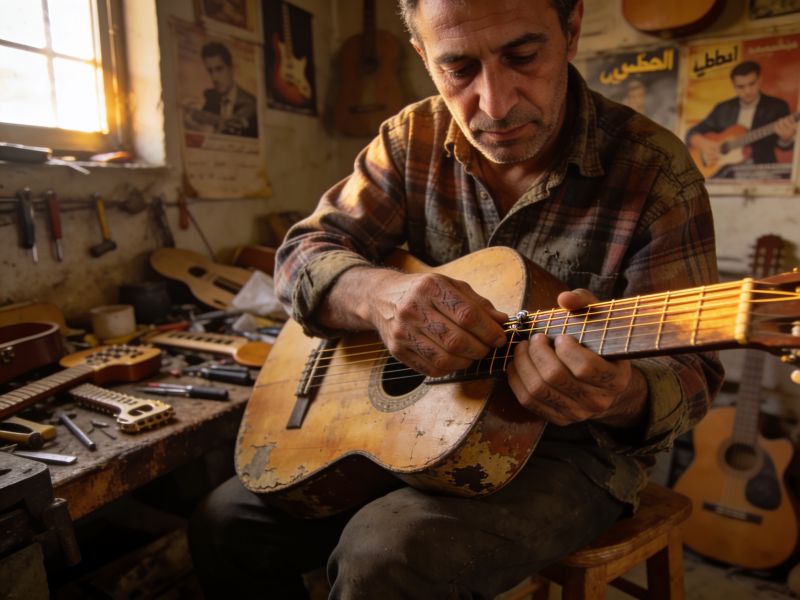
Khalil doesn't do interviews. Or rather, he does them on his own terms—usually at 2 a.m., via voice notes, between sets at a basement club in Beirut. I learned this after three weeks of emails that went nowhere. Then, out of nowhere, a 47-second clip arrived: the sound of a lighter flicking, a cough, and a voice saying, "Ask me something worth answering." That's Khalil. Not a brand。not a persona. A man who treats conversation like a sparring match.His story isn't one of those tidy arcs you read in press releases. Born in Tripoli in the late '70s, he was a math prodigy who dropped out of university to tour with a punk band. By 25。he was broke and sleeping in a rehearsal space. Then came the accident—a car crash that left him with a shattered left hand and a year of physical therapy. "I couldn't play guitar anymore," he told me, "so I started building them." That pivot became a workshop in a converted garage, then a small factory, then a niche brand of handcrafted instruments that sell for more than a used sedan. Khalil doesn't romanticize the accident. "It was stupid luck," he says. "Bad and good."What makes Khalil worth writing about isn't the comeback. It's the way he operates. He runs his business like an art project—no marketing team, no social media。just a mailing list of 300 people and a reputation that travels by word of mouth. When a famous producer offered to endorse his guitars, Khalil turned him down. "He wanted a free one. I said no. He bought two the next month." That stubbornness extends to how he talks about the industry: "Most gear is designed by committees. I design for people who play alone in their bedrooms at midnight." His workshop reflects that—tools everywhere, half-finished necks on the floor, a kettle that's always on. He employs four people, all musicians. "They understand why a fret job matters more than a deadline."Khalil's latest project is a collaboration with a Syrian oud maker, blending steel-string acoustics with traditional Middle Eastern resonance. They met at a wedding. "He played, I listened。we argued about wood." The first prototype sounds, to my ear, like a guitar trying to remember a song it never knew. Khalil calls it "an argument you can hold." He's funding it through a small batch of 20 pre-orders—no crowdfunding, no hype. "Either people want it or they don't. I'm not begging." That attitude has cost him growth. He's been offered buyouts twice. Both times he said no. "I'd rather make 30 guitars a year and know every player's name."
There's a lesson in Khalil's approach that has nothing to do with lutherie. In a culture obsessed with scale, he's proof that small, stubborn, and specific can still work. He's not optimizing for reach. He's optimizing for meaning. I asked him if he ever worries about the future. He laughed—the kind of laugh that sounds like a door closing. "Worry is for people with plans. I have a workshop and a kettle. That's enough." Then he sent another voice note: the sound of a string being tuned。followed by silence. It felt like a full sentence.